

Quick Links
Web-Based Instruction
Carnivore Anatomy Courseware
(Arranged Categorically)
To view a web site click its title.
Courseware Recommendations for Veterinary Anatomy Students
Recommends courseware available on this web site for veterinary students taking a first-year anatomy course (CVM 6903).
Gross Anatomy Courseware:
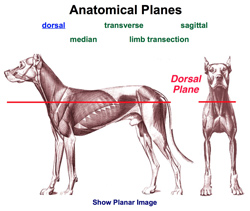
Anatomy Directions, Planes, and Muscle/Joint Actions
Animations and descriptions of directional terms, anatomical planes, and muscle/joint actions pertinent to veterinary anatomy, including conflicting human anatomy terms, are presented. Cartoon animations (created using Adobe Edge) illustrate the terminology. They may be viewed on computer screens or mobile devices.

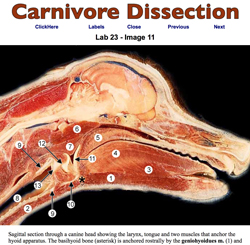
Carnivore Dissection Labs
A web site designed for students studying Veterinary Anatomy at the University of Minnesota. Laboratory objectives, terminology, instructor commentary, dog & cat dissection videos and a dozen or so labeled cadaver images with captions are presented for each of 25 labs devoted to carnivore (dog/cat) dissection. The web site enables students to preview content before a lab and/or to review lab content before an exam. Students can toggle cadaver image labels on/off to self-assess their anatomical knowledge.
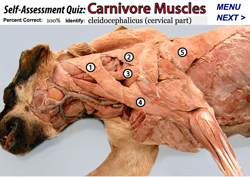
Carnivore Muscle Identification: Self-Assessment Quiz
This web site presents images of dissected muscles from dog & cat cadavers. The muscles are displayed in a quiz context, enabling veterinary students to self-assess their knowledge of muscle identification. Per selected muscle group, students are repetitively asked to identify a randomly presented muscle by choosing among randomly numbered labels on randomly chosen images. Either the mouse or keyboard can be used for muscle selection and for navigation.
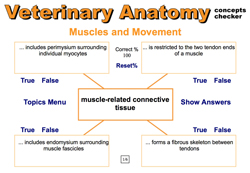
Veterinary Anatomy Concepts Checker
This web site focuses on anatomical concepts, giving students an opportunity to clarify conceptual understanding via self-assessment. Per subject category, a series of query screens is presented randomly. Each screen consists of a centrally placed statement surrounded by four randomly positioned phrases that are either true or false. A Show Answer button reveals your success and offers a conceptual explanation.
Peripheral Nerve Courseware:
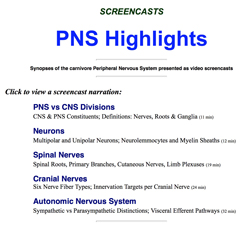
PNS Highlights Video Screencasts
Narrated synopses (screencasts) that highlight the carnivore Peripheral Nervous System are presented as streaming video clips (mp4 videos). The video topics are: 1] PNS vs CNS divisions of the nervous system; 2] Neuron and Neurohistology background information; 3] Spinal Nerves; 4] Cranial Nerves; and 5] Autonomic Nervous System.
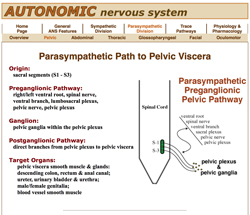
Autonomic Nervous System
This web site presents autonomic nervous system anatomy and autonomic physiology/pharmacology. Visceral efferent nerve pathways to canine body regions are emphasized. The web site features animated tutorials for learning pathways and animation quizzes for tracing one's knowledge of sympathetic and parasympathetic pathways to regional visceral organs.
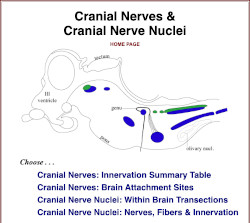
Cranial Nerves & Cranial Nerve Nuclei
This web app presents a stand-alone interactive tutorial for canine cranial nerves and cranial nerve nuclei, including: a cranial nerve innervation summary table; canine brain attachment sites of cranial nerve roots; identification of nuclear neuron columns per fiber-type in brainstem cartoons; cranial nerve nuclei shown within brainstem transverse tisue sections; and cranial nerve & nuclei innervation targets. The web app may be used to supplement neuroanatomy lab materials pertaining to cranial nerves and nuclei.
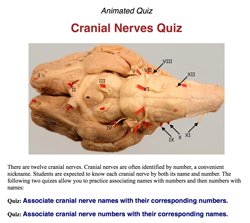
Cranial Nerves Animated Quiz
Animated quizzes are presented for students to reinforce their knowledge of the names, innervation targets, and fiber type content of cranial nerves. The quizzes demonstrate the correct answer when a choice is made. Each time RESET is clicked, a new randomized version of the quiz is presented. (These animations require browsers to use a Flash Player plug-in.)
Planar Anatomy Courseware:
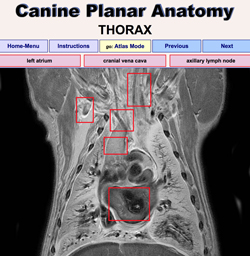
Canine Regional Planar Anatomy Quizzes
This web site enables students to explore canine planar anatomy. MRI, CT and Cadaver-Slab images, displayed in Transverse Plane, Dorsal Plane and Sagittal Plane views, are presented in random order per body region. Two modes of presentation are available: In Quiz Mode, three terms and five target frames are shown per image. Students match terms to frames by dragging or sequentially clicking/tapping. In Atlas Mode, numerous labels per image may be toggled on/off.
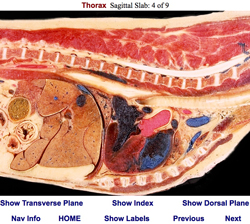
Canine Cadaver Planar Anatomy (cadaver slabs)
Canine planar anatomy is presented as 900 x 600 pixel images of cadaver slabs produced by bandsawing frozen cadavers. The head/neck, thorax, and abdomen/pelvis regions are each shown in three planes: sagittal (left to right lateral views), transverse (cranial/rostral to caudal, caudal views), and dorsal (dorsal to ventral, dorsal views). Keyboard arrow keys may be used to navigate among images per plane per region. Use the spacebar or click/tap an image to toggle labels.
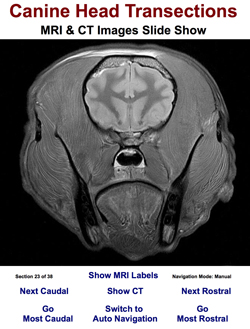
Canine Head Transections (MRI & CT Slide Show)
This web app presents a slide show of MRI and CT axial (transverse plane) images through the head of an embalmed, latex-injected, brachycephalic, mongrel canine cadaver. The web app enables students to explore planar head anatomy thoroughly and to compare MRI vs CT views at each transverse level. MRI and CT images are synced during rostral-caudal navigation, which can be manual or automatic (at an adjustable rate). During manual navigation, MRI labels may be displayed (using a button or the spacebar). The keyboard can be used for navigation (arrow keys) and to toggle MRI/CT display (shift key). The auto navigation mode gives students an overview of head planar anatomy. The MRI labels that become available during manual navigation provide detailed identification.
Additional Planar Anatomy Courseware
Link to additional planar anatomy, including MRI and CT, courseware on this web site.
Urinary Tract Courseware:
Carnivore Lower Urinary Tract
This web site presents Embryonic Development, Anatomy, Innervation, Physiology, and a Clinical Case Example pertaining to the lower urinary tract of the dog and cat. In addition, there is a Knowledge Self-Assessment section featuring True/False quizzes geared for instruction, rather than grading. Each quiz page is linked to a pop-up tutorial page. (If a border appears when you mouse-over an image, you may click the image to view pop-up information or an enlarged image.)
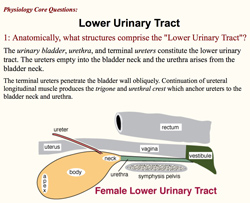
Core Questions: Lower Urinary Tract
This computer and mobile device web app presents core questions related to the Urinary Tract. Students are expected to think about how they would answer each question before revealing the short answer and then the detailed answer provided by an instructor.
Applied Anatomy Page: Lower Urinary Tract
This web page was developed for clinical Residents interested in reviewing applied anatomy of the canine and feline Lower Urinary Tract (LUT). The web page provides links to online resources including a PDF file containing the images used in a presentation of LUT Applied Anatomy. The presentation is organized as a series of questions and is intended to be interactive. The target audience is encouraged to express answers to each question and then react to instructor explanations.
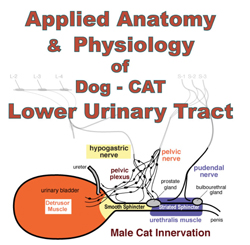
Applied Anatomy and Physiology of the Dog & Cat Lower Urinary Tract
This presentation of anatomy and physiology of the ureter, urinary bladder and urethra is available for download as either an eBook or a PDF document.
Veterinary Urinalysis Interpretation Quiz (mobile web app)
This web app was developed for students in clinics who wish to self-assess their capability to correctly interpret canine and feline urinalysis results. Following direct or random selection of a clinical case, multiple choice questions regarding interpretation of the urinalysis results are presented. Buttons are available to view the results, to choose or reveal the correct answer, and to display normal canine or feline urinalyses for comparison. (The web app was designed for smart phones, but it works as well for tablet or computer screens.)
Miscellaneous Courseware:
Designed For Running
This web site presents anatomical adaptations for running in ungulate and carnivore quadrupeds, contrasting design compromises that are imposed by diet (herbivore vs. carnivore).
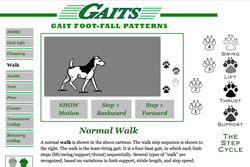
Canine Gaits
This web site presents gait descriptions and employs cartoon animations to help veterinary students recognize the major gaits of cursorial quadrupeds (running animals), using the dog as a model. The ability to recognize gaits and anticipate foot-fall patterns in a moving animal is essential for identifying gait abnormalities.
Canine Gaits (mobile web app)
This Gaits web app is designed for smart phones and tablets. It presents gait descriptions and employs cartoon animations to help veterinary students recognize the major gaits of cursorial quadrupeds.
Veterinary Anatomy Concepts Checker (mobile web app)
This mobile Veterinary Anatomy Concepts Checker is a web app designed for smart phones. For each selected Topic, pertinent concepts are presented in the form of a statement and four associated True/False questions.
Carnivore Anatomy Terms List (CVM 6903)
A list of carnivore anatomy terms organized by disssection lab, developed in 2017 for a University of Minnesota carnivore anatomy course (CVM 6903).
External URL Links:
Link: A Guide For Dissecting the Dog
Dr. Paul F. Rumph, Professor Emeritus, Auburn University has compiled an on-line canine dissection guide that presents dissection instructions with images plus clinical notations.
Link: University of Illinois Radiographic Anatomy Imaging
The University of Illinois has produced an outstanding web site for viewing normal radiographic anatomy images. The canine is most thoroughly presented, followed by feline, equine and bovine images. The site is still undergoing development. Your browser must activate a Flash Player to view this web site.
Link: Carnivore Dissection Labs -- in Chinese
Our Carnivore Dissection Labs website has been translated into Chinese.
- Courseware Recommendations for Veterinary Anatomy Students
- Anatomy Directions, Planes, and Muscle/Joint Actions
- Carnivore Dissection Labs
- Carnivore Muscle Identification: Self-Assessment Quiz
- Veterinary Anatomy Concepts Checker
- PNS Highlights Video Screencasts
- Autonomic Nervous System
- Cranial Nerves & Cranial Nerve Nuclei
- Cranial Nerves Animated Quiz
- Canine Regional Planar Anatomy Quizzes
- Canine Cadaver Planar Anatomy
- Canine Head Transections (MRI & CT Slide Show)
- Carnivore Lower Urinary Tract
- Core Questions: Lower Urinary Tract
- Applied Anatomy Page: Lower Urinary Tract
- Veterinary Urinalysis Interpretation Quiz
- Designed For Running
- Canine Gaits
- Canine Gaits (mobile web app)
- Veterinary Anatomy Concepts Checker (mobile web app)
- Carnivore Anatomy Terms List