
| Home Page |
General ANS Features |
Sympathetic Division |
Parasympathetic Division |
Trace Pathways |
Physiology & Pharmacology |
Note: This website employs SVG animations that display best with Chrome or Firefox browsers.
This canine Autonomic Nervous System tutorial focuses on visceral efferent pathways that innervate smooth muscle, cardiac muscle, and gland tissue in the dog. An overview of physiological and pharmacological aspects of Autonomic Nervous System operation are also included. Web site information can be accessed via the above navigation bar (click to view a topic).
NOTE: The term "autonomic" means self-rule/self-govern [from the Greek: auto = self; nomos = rule]. The name implies that visceral innervation operates involuntarily on its own (in contrast to the voluntary control characteristic of somatic innervation of skeletal muscle). Visceral organs generally operate below conscious control, even though one can initiate/inhibit some visceral activities (e.g., urination, defecation) and indirectly influence others (e.g., heart rate).
The phrase Autonomic Nervous System (ANS) can be used in three contexts:
1] ANS refers to Visceral Efferent (VE) innervation of viscera, i.e., the two-neuron peripheral pathway from the Central Nervous System (CNS) to visceral organs. This is the original anatomical definition and it is a major focus of this web site, i.e., identifying VE pathways to viscera located in different regions of the body.
2] ANS refers to General Visceral Afferent (GVA) as well as Visceral Efferent (VE) peripheral innervation of viscera and to visceral relexes. Visceral efferent and afferent axons both use the same peripheral nerve pathways, and both are necessary for visceral reflexes.
3] ANS refers to visceral peripheral innervation plus selected brain components that regulate visceral activity. To view CNS components associated with the ANS (in a separate page) click here: CNS Visceral Control Summary.
General ANS Features: an introduction to the Autonomic Nervous System (ANS):
two-neuron VE pathways; sympathetic & parasympathetic divisions; enteric innervation.
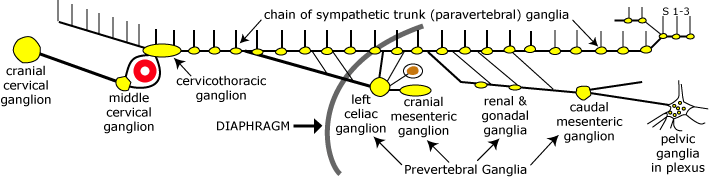
Sympathetic Division: presents the thoracolumbar division of the ANS and turorials
for learning sympathetic VE pathways to six body regions: head, neck, thorax, abdomen, etc.
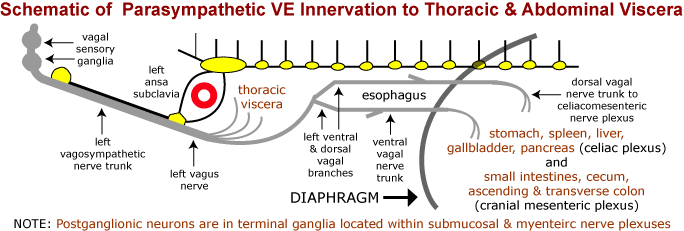
Parasympathetic Division: presents the craniosacral division of the ANS and turorials
for learning parasympathetic VE pathways to the head, thorax, abdomen, and pelvis.
Trace Pathways: provides opportunities to demonstrate knowledge of ANS pathways by revealing VE pathways to target organs and by taking animated quizes to construct pathways.
Physiology & Pharmacology: highlights physiological and pharmacological features of the ANS, including self-assessment questions, drug information, and a CNS summary.
© 2010, 2020
T.F. Fletcher fletc003@umn.edu
and
D.R. Brown brown013@umn.edu
Last modified February 2020
Supported by University of Minnesota College of Veterinary Medicine
The University of Minnesota is an equal opportunity educator and employer.
